

House fires have increased, most often in summer but now also in winter because of energy poverty, so having fire safety systems is now considered essential.
Specialist companies undertake the installation of fire safety systems, taking into account both the legislation and the particular features of each building and space. However, according to professionals working in the fire safety and fire protection equipment sector, there are also lower-cost solutions.
From the simplest option, buying portable fire extinguishers, since the small household-type ones are not enough, up to more complex applications such as automatic detection and suppression systems, every kind of need can be covered effectively. If the home is not at risk from forest fire, a quick, easy and affordable way to protect your property is to install at least portable (simple) fire detectors, which, although not required by current fire protection legislation, will sound an alarm in the event of a fire. Fire detectors come in different technologies depending on the conditions of the space where they are installed (ionisation, heat, photoelectric).
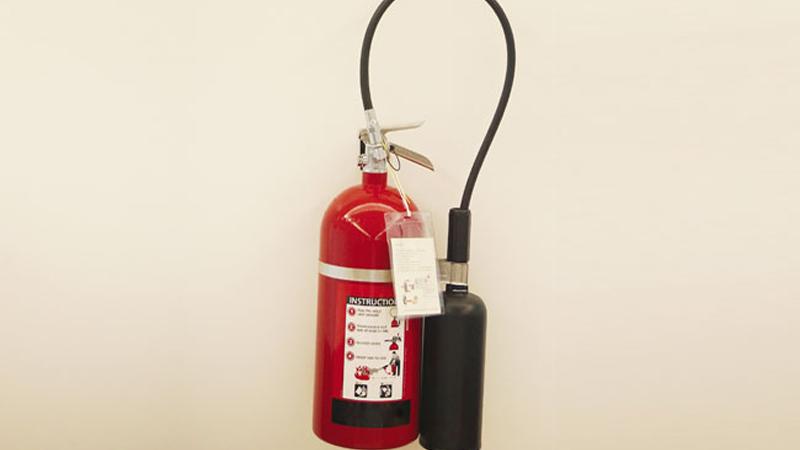
Buying 6 kg portable fire extinguishers (each one can cover 30 m²) is considered essential for an average house near a forest area. However, no one can guarantee they will be effective when a fierce fire is ravaging a nearby pine forest. In that case it is a good idea to have wheeled fire extinguishers, which are much larger. They come in two sizes, 25 and 50 litres. A label on the body of the extinguisher states its type, the fire classes it is suitable for, its fire rating for the different fire classes, and whether or not it is suitable for areas with live electrical equipment. Fire extinguishers should be serviced every year, which means agitating their contents and checking the pressure, and they should be recharged immediately after use.
For holiday homes, and not only those, experts also recommend installing a water curtain. Specifically, small water nozzles are fitted around the perimeter of the roof to create a curtain of water that soaks the outer surface of the walls.
A fire safety system with fire detection and automatic suppression covering the whole house is a more complete solution, but the cost goes up. Note, however, that the fire protection study must be carried out by a mechanical engineer.
In addition, if the house has a swimming pool, its water can be used. Of course, a pump and a pressure booster are needed so that the water can be pumped, and at the necessary pressure.
Fire-resistant window and door frames, and above all fire-resistant doors, also known as fire doors, play an important role in slowing down and containing a fire.
Most of the above, and of course much more, concern active fire protection, which complements passive fire protection.
Active fire protection includes fire detection, fire alarm and fire fighting. In an automatic fire detection system we find the following:
- Fire detectors
- Manual call points
- Sounders/buzzers
- Central control panel
- Signal transmission system.
In more detail, fire fighting equipment consists of:
- Portable equipment (portable fire extinguishers, CO2 and dry powder)
- Wheeled equipment (CO2 and dry powder)
- Fixed systems (automatic dry powder ceiling fire extinguishers, fire hose cabinets, hydrants, sprinklers).
As for passive fire protection, it is divided into:
- Structural fire protection
- Fire compartmentation
- Smoke control
- Escape routes & emergency exits
- Emergency lighting
- Escape route & emergency exit signage.
Three key points for protecting homes in forest areas
According to Hellenic Fire Service experts, homes built on the slopes of hills and mountains, especially on steep ground with tall, flammable vegetation, are dangerous for their occupants unless adequate protection measures against forest fires have been taken first.
Three factors matter most in strengthening the protection of homes in forest areas: the quality of construction, accessibility and an adequate water supply.
More specifically, the fire safety requirements of the area must be taken into account when roads are designed. Safe access requires roads and road networks with no dead ends, wide enough to allow fire engines to travel in both directions in an emergency and residents to evacuate safely. Branches touching high-voltage cables should also be removed, and roads must be kept clear of shrubs and dry grass.
Every home in a forest should have an adequate supply of water and equipment to spray it if a fire breaks out. The greater the amount of water, the more effective the suppression system. This is because firefighters need huge amounts of water once a fire grows large. A swimming pool, an artificial pond or a tank can prove a lifesaver if the water reserves of the fire pumps run out.
Before you even buy land to build a home, consult the local authorities about the fire safety measures in place in the area you are interested in.
Bear in mind that your house should, as far as possible, stand on the level part of the plot, which is always safer than a sloping part.
Check whether signs with street names and house numbers, easily visible from the road, have been put up in your area, so that firefighters can find your home.
Homes with a timber roof are more likely to ‘catch’ fire from a forest fire. To avoid this, make sure the roof is made only of non-flammable or fire-resistant materials. You should also regularly clear it, as well as the gutters, of rubbish and plant debris.
When drawing up the plans for your home, take measures so that embers from a fire that may break out in the adjacent forest cannot get inside the house, and, conversely, cannot ‘jump’ from inside the house to the forest.
External walls should be built entirely of fire-resistant materials. It is also very important to keep all kinds of flammable vegetation, woodpiles and rubbish away from the walls. For extra safety, cover all chimneys, the outside of the attic and the underground ventilation ducts with a special fine-mesh wire screen.
Create a firebreak around your house to reduce the amount of combustible material surrounding it. In most areas, the firebreak can extend at least 10 metres from the house. When the ground slopes, however, the width of the firebreak should increase with the gradient.
Piles of firewood should be placed at a safe distance from the house and generally away from anything flammable. Your home should have several emergency exits, on every level, so that you can escape in the event of a fire.