

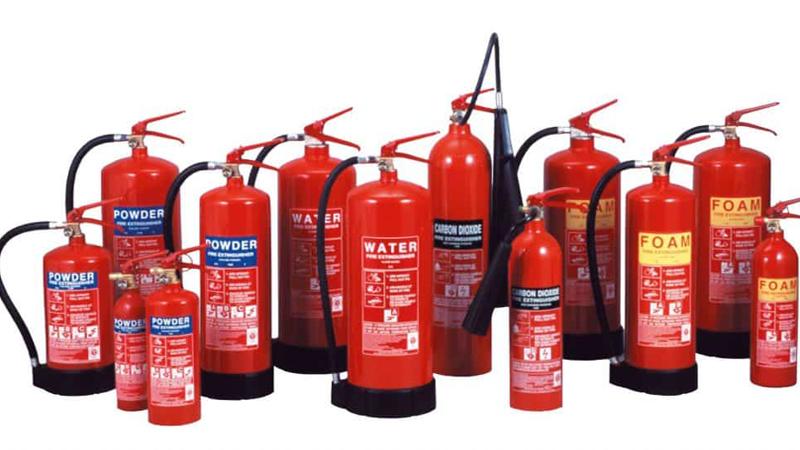
Not every extinguisher puts out every fire. For homes, offices and shops the usual choice is the ABC dry powder extinguisher. For electrical panels and electronics, carbon dioxide (CO2) or a clean agent. For cooking oils and fats, a wet chemical extinguisher. In a car, Greek law requires a dry powder extinguisher. Here is why.
Fire classes
The European standard EN 2 divides fires into five classes by what is burning. The class is shown, with its symbol, on the label of every extinguisher.
| Class | What burns | Examples |
|---|---|---|
| A | Solid materials | Wood, paper, fabric, many plastics |
| B | Liquids or solids that melt | Petrol, diesel, solvents, paints, wax |
| C | Gases | LPG, natural gas |
| D | Metals | Magnesium, sodium, metal powders |
| F | Cooking oils and fats in cooking appliances | Deep fryer, a pan of oil |
Electricity is not a fire class. An extinguisher that may be used on live electrical equipment says so on its label, usually for up to 1000 V from a distance of one metre.
Types of fire extinguisher
ABC dry powder
It puts out class A, B and C fires, which is why it is the most common. It is the type Greek law asks for in shops, apartment buildings and cars. It leaves powder behind, to be cleaned up afterwards. See our dry powder extinguishers.
Carbon dioxide (CO2)
It puts out class B and C fires. It leaves no residue, so it is preferred for electrical panels, plant rooms and boiler rooms, where the law requires it in shops. It is not suitable for solid materials (class A). See our CO2 extinguishers.
Foam
It puts out class A and B fires: solids and flammable liquids.
Water
For class A fires. On live electrical equipment it may be used only if its label allows it.
Wet chemical
The class F extinguisher, for kitchens. On an oil fire, powder, CO2 and ordinary foam knock the flame down, but the hot oil reignites. Water is dangerous, because it throws the burning oil out. Wet chemical covers the oil and cools it. See our wet chemical extinguishers and fire safety for restaurants and commercial kitchens.
Clean agent
It extinguishes with a gas, such as HFC-227ea or FK-5-1-12, and leaves no residue. It is used where powder or water would cause damage: electronics, servers, archives. See our clean agent extinguishers.
Special types
Automatic ceiling extinguishers, aerosol-type extinguishers, stand-alone systems for the home kitchen and more, among our special-type extinguishers.
What 21A-113B-C means
It is the extinguisher's fire rating, printed on its label. The number before A shows how large a fire of solids it put out in the standard's test, the number before B how many litres of flammable liquid, and the C that it is suitable for gases. The larger the numbers, the greater the capacity.
Greek law sets minimums: 21A-113B-C for extinguishers in shops and new buildings, 55B-C for CO2 extinguishers in shops' plant rooms, and 8A, 34B, C for the car extinguisher.
Which one each place needs
- Apartment building: for buildings put up after 7 August 2018, one extinguisher per floor in the common areas. For older buildings, see the guide Fire extinguishers in apartment buildings.
- Detached house: for buildings of the same period, one portable extinguisher in every detached house, whatever its floor area.
- Car: one "Type 1" dry powder extinguisher, for classes A, B, C and electrical current up to 1000 V, rated at least 8A, 34B, C.
- Shop and office: dry powder or water-based extinguishers, at least 21A-113B-C, one per 150 m² and no fewer than two. Details in the guide Fire safety for shops.
- Commercial kitchen: a wet chemical (class F) extinguisher and a suppression system in the hood. See fire safety for restaurants and commercial kitchens.
- Electrical panels and electronics: CO2 or clean agent, and automatic systems for electrical panels.
- Boiler room, garage, fireplace: automatic suppression, as the article Automatic fire suppression in domestic boiler rooms, garages and fireplaces describes.
After you buy
Every extinguisher needs servicing every year and recharging after every use. The intervals for each type are in the guide Fire extinguisher servicing and recharging. For the extinguisher that suits your premises, call us on +30 210 81 00 613.
Sources
- EN 2: fire classes; EN 3-7: extinguishers, fire ratings, use on electrical equipment.
- Fire Service Ordinance 8/2016, Gazette B' 165/2017 (in Greek), article 7: extinguishers in shops.
- Presidential Decree 41/2018, Gazette A' 80/2018 (in Greek): extinguishers in dwellings and minimum ratings.
- Ministerial Decision 50292/3549/2009, Gazette B' 272/2009: the car extinguisher.